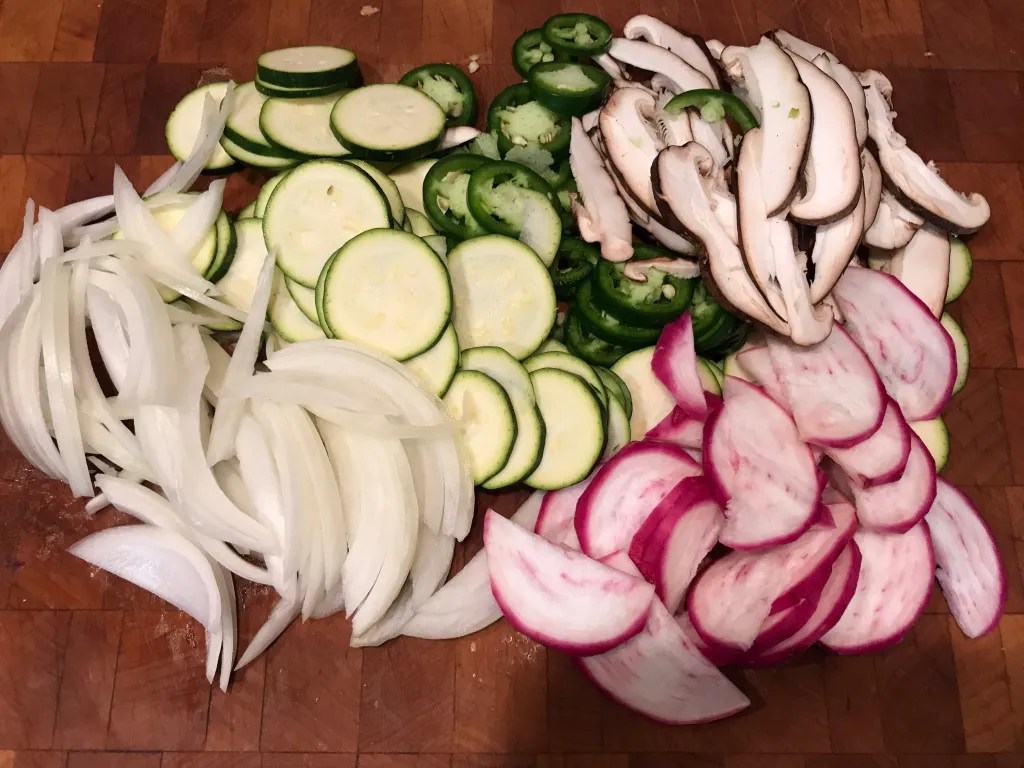
A twist on Pickled Veggies

Inspired by OG Veggies of Island Fin Poké, this marinated dish is stunningly simple to stir up. If you are in the neighbourhood, you must give this place a try– not just for its healthy offerings, but also its warm, cheerful and welcoming owner (who also happens to be a good friend!).

Just a little knife skill and a few stock pantry ingredients is all it takes to whip this pickle up. Enjoy!

SPECIAL TOOLS:

Mandolin or a sharp kitchen knife; Mason jar.

INGREDIENTS

  • Marinade: 1/4 cup soy sauce + 1/4 cup brown rice vinegar + 1 tbsp sesame oil + 1 tbsp hot EVOO
  • Organic Veggies (mandolined or sliced thin):
    • 2 shiitake caps + 1/2 white onion + 1 small zucchini + 1/4 turnip + 1 jalapeno

METHOD

Place the sliced veggies in a mason jar and pour the liquid marinade. Marinade for 24 hours.

NOTES, HINTS, TIPS:

  1. Turn the mason jar around, in intervals, so as to distribute the liquid uniformly around, as much as possible. The marinade is rather strong and so the small amount is enough for the whole jar.
  2. I used hot EVOO– which broke the usual veggie monotony with some heat.

Spirulina Rolls

A page from Rajasthani Bati, another from Chinese Mooncakes, a dab of nutritional blue-green algae and voilà! A superfood roll.

The spirulina powder by itself is reminiscent of the beach, but dressed in the roll is quite neutral. I adapt Moringa Bati here using the the mooncake technique of wrapping dough around the spirulina stuffing. Tastes even better than it looks. Enjoy!

SPECIAL TOOLS:

An oven or just a toaster oven; mooncake stamps.

INGREDIENTS

  • Dry ingredients:
    • 2 cups whole wheat flour (atta)
    • 1/2 tsp salt (to taste) + 1/2 tsp ground pepper
    • Leavener: 1/4 tsp baking soda + 1/4 tsp baking powder
    • 2 cups grated Parmigiano Reggiano + leaves of 2 fresh Rosemary stalks
  • Wet ingredients: 4 tbsp yogurt + little (2-3 oz) water to make a dough
  • 2 tsp Spirulina powder
  • EVOO to brush the mooncake stamp

METHOD

Mix all the dry ingredients and divide into two parts and add the spirulina powder to one. Make two separate doughs using the wet ingredients. Rest the two doughs (one light and the other dark) for 30 minutes.

Divide each dough into 8 portions. Roll the light ball into a thin disc of about 3.5-4 inches in diameter, place the dark ball in the center; wrap the dough around it and place on silicone silpat, crease side down. Similarly make a roll with the dark dough as the wrapper. Make the 8 balls and press with the mooncake stamp.

Bake at 375 F for 15 minutes. Rotate the tray and bake for another 10 minutes. Serve hot.

NOTES, HINTS, TIPS:
  1. The EVOO of the stamp also brushes the rolls with oil. Use the best EVOO you have.
  2. If you don’t have a mooncake stamp, leave them as balls like in the bati (and brush with cold water).

Christmas Murukku

A giant murukku is fun to serve at a cozy gathering, as a communal snack. This unusual size takes a little dexterity to pull off but worth the effort. Enjoy!

Special tools:

Murukku (extrusion) mould; Silicone silpat or wire rack with the baking tray.

Ingredients

  • 1 cup rice flour + 1 cup besan
  • 1 tbsp ajwain (carom) + 1 tbsp white sesame seed + 1/4 tsp freshly ground black pepper + 1 tbsp EVOO + salt to taste

Make a hard dough using a little cold water (about 3 oz). Divide the dough into two equal halves and shape each into a cylinder to fit the mould. I used one half to make a gigantic swirl and the other half to make about a dozen small ones (see picture). Gently place the swirls using spatula on a wire rack or a silicone silpat.

Bake at 275 F for 30-45 mins till crisp (and oak colored). Cool and serve or store in airtight container.

Notes, hints, tips:
  1. Note the traditional murukku is deep fried.
  2. Use rice flour from Indian grocery stores, not SouthEast Asian stores. The latter is usually not preprocessed and is glutinous– this will not work for this recipe.
  3. If the dough is soft, it will not retain the tiny spikes (from the star-shaped hole in the disc of the mould) while extrusion, so make sure the dough is pliable but on the hard side.
  4. Lie the mould flat on the edge of the counter and use the lever handle (as you would a pasta roller). This technique is unorthodox but effective.

Kimchi Potato Galette

Hannukkah brings potatoes to the forefront with its iconic latke. But here is an apostatic version, without the frying oil but bursting with flavor from kimchi, scallions, sesame seeds… Enjoy!!

Special tools:

Parchment paper or silicone silpat; Food processor or grater.

Ingredients

  • 1 cup kimich + 1 tbsp gochujang (if kimichi is not already too hot), finely diced in processor
  • 1 lb potato (if organic, no need to peel), coarsely grated
  • 4 scallions + 1/2 small yellow onion, finely diced
  • 1/3 cup besan + 2 tbsp oil + salt to taste + pepper
  • Filling: 1/2 cup goat cheese + 2 tbsp sesame seeds
  • Garnish: microgreens

Mix all the first four ingredients well. Line a baking tray with parchment or silpat: you need this to help you roll.  Make a mat of the mix on the parchment, about 1 cm in thickness. Loosely pat it down and level off the edges. Bake in the middle rack, at 400 F for 25 mins.  Check on it for the last 10 minutes, to rotate the sheet or pull it out of the oven if already done.

Dot with goat cheese and sesame seeds. To serve either just cut into squares, or, roll and slice. Sprinkle with microgreens and serve with sour cream or yogurt.

Notes, hints, tips:
  1. The combination of kimchi and potatoes is inspired from The Week’s latke recipe by Evan Bloom. I am not sure if fermented kimchi is kosher, but nevertheless.
  2. Besan is chickpea flour and is available at Asian (Indian) groceries, or you can simply order over the internet.
  3. You can use eggs instead of besan.
  4. I simply use the processor bowl as the mixing bowl by first using the blade to process the kimchi; then the coarse grater to grate the potatoes. For the classical latke, one laboriously squeezes out the water from the potatoes– here I don’t and I simply use besan to absorb the excess liquid while providing an additional layer of flavor.

Shishito Eggplant

Lightly blistered with a sprinkling of sea salt, Shishito has rapidly become a popular finger food. At this time of summer, the weekly CSA (Community Shared Agriculture) supply always has a generous bag of these Japanese peppers. Here I change the shishito playbook by using it with CSA Japanese eggplant, for an equally simple and delightful result. Enjoy!

Special tools:

Wok.

Ingredients

  • 4-5 Japanese long eggplants, chopped into chunks, soaked in plenty of water
  • 8-10 shishito peppers, destemmed (use kitchen scissors)
  • 2-3 garlic pods, chopped very fine
  • 2 tbsp EVOO
  • salt to taste

Method

Heat the oil with the finely chopped garlic. Drain and sdd the eggplants and salt. Mix well and then cover to let it cook in steam for 5-7 minutes, under medium heat. Mix in the shsishito and stir-fry for 2-3 minutes.

Notes, hints, tips:
  1. I use the Japanese chopping technique of chopping the eggplant into irregularly shaped chunks, by chopping at an angle.
  2. The kitchen scissors is very convenient for the peppers, to slit and remove the internal seeds.

An even easier microwave version: Mix all the ingredients well and place in a microwave-proof bowl and covered with moist kitchen paper towel. Nuke for 6 mins+3 mins (check and adjust appropriately).

Desert Cuisine: Rajasthani Ker Sangri

At the July 4th Barbecue, I was tasked with a vegetarian side-dish. Taking a gamble, I turned to Rajasthan, a state in India’s northwest that almost completely encompasses Thar desert (also called the Great Indian Desert). My wager paid off. With timely tips from my Udaipur friend Pankaj, Ker Sangri was a resounding hit !!

A few weeks ago I had ordered panchkutta— a mix of five kinds of dried vegetables– for this iconic Rajasthani dish. The shipping fee was ungodly, but so was my enthusiasm. The package arrived all the way from Jodhpur, to my complete amazement (I thought there would be a local NJ supplier 🙂 )

Regional Indian Cuisines never fail to amaze me. Truely. The five classic tree ingredients of this dish are ker, sangri, koomatiya, goonda, and mango. Koomatiya in particular caught my attention- it is the berry of a variety of mimosa native to Sudan! So with a fascinating backdrop of food anthropology, hyper-traditional-meets-modern-accessibility, ker sangri came together for a finger-licking finale. Enjoy!

Special tools:

None.

Ingredients

  • Tree ingredients: Soak in water for 2-3 hrs (or, till bite-test) 1/2 cup sangri + 1/4 cup each of ker, koomatiya, gunda
  • Sour: 2-3 dried mango pieces soaked in 1/2 cup water (while you soak the above)
  • Sweet: 2 tbsp raisins soaked in 1/4 cup water
  • Spices: 1/8 tsp turmeric + 1/2 tsp red chilli powder + 1/4 tsp coriander powder + a pinch heeng
  • Tempering: 1/4 tsp ajwain + 2 bay leaves + 2 whole dried red chilies
  • 1 tbsp neutral oil

Method

Drain the hydrated tree ingredients. Heat oil. Add all the tempering ingredients. When the seeds pop lightly (about 1 minute) add the spices and quickly mix (without burning) for 10 seconds or so. Add all the hydrated tree ingredients and fold in. Next add the sour and sweet ingredients along with their soaking water. Cover and let meld together for 8-10 minutes. Taste for seasonings and adjust to your taste. Serve hot.

Notes, hints, tips:
  1. I ordered the ingredients from Spice Platter.
  2. If you have a scale, then use 100 gm of sangri to 50 of gm each of ker, gunda, kumatiya.
  3. My version was light both in oil and spices, contrary to recommendations. Feel free to adjust to your taste. I found that I did not even have to salt it. Wonder why.
  4. Here are some interesting sources that you may like to read and view.

Photo: Tree ingredients pre-soaked; Hydrated, drained ingredients; Sautéed vegetables.