Silk Road: Kashmiri Kahwa Tea

In my last trip to India, I was introduced to this incredibly fragrant, flavorful, gentle Kashmiri Tea. Green tea with saffron, rose petal and sweet spices. I am a tea junkie and I feel obliged to share this one. What sets this apart, in my mind, is the use of delicate sweet spices and multiple infusions (ala some high-end Chinese tea).

Using a 21st century “samovar”, you can use multiple infusions to last you an entire afternoon of incessant flavorful tea from a scant teaspoon of tea. See picture: this pot has no beak, the tea comes out of its bottom – pardon my language- into the drinking cup. Enjoy!

Filtering from pot to cup…
Special tools:

A Steeping pot; an electric kettle for heating water.

Ingredients

  • 3/4 tsp Kashmiri green tea
  • 8-10 strands saffron
  • 1/4 tsp edible dehydrated rose petals
  • Sweet spices: 3-4 whole green cardamom pods + 1 inch canela (Mexican cinnamon stick)
  • Optional: dash of Himalayan pink salt

Method

Bring a cup of water to 198 F. Place all the above ingredients in a teapot and pour the hot water into the pot and let steep for about thirty seconds. Strain into a drinking cup.

You can use multiple infusions- don’t discard the tea mix but use fresh hot water for a second, third and even fourth cup of tea. Adjust the steeping time to your preference.

Notes, hints, tips:
  1. The Himalayan pink salt is my contribution to this classic mix: the salt rounds out the flavor (and I believe helps your body absorb water).
    My grandfather used to take a little salt in his tea and the rest of the family scoffed. Now I totally understand.
  2. What makes this Kashmiri tea work with the very delicate flavors of saffron and rose petals is the use of green, not black, tea. The Mexican canela is milder than the regular Malabar or even Saigon cinnamon.
    My regular go-to tea has been the kadak (strong) CTC -Crush, Tear, Curl- pellet, also called mamri tea. But just once a day. For the rest, I flirt with these other gentle, soul-caressing ones.
  3. The tea gets stronger with longer steeping time. So you can adjust based on your preference. This tea is more amenable to multiple infusions.
    There is nothing worse than lukewarm tea; so keep the water hot.
  4. In my trips to Hong Kong, I had seen the use of porcelain (China) teapots for multiple infusions at tea tasting events. You can use Chinese teapots if that is more easily available for you.
    The teapot shown in the picture here was bought at Teavana in New York. It is very convenient to use: once the steeping is done, you simply place the pot on your cup and the built in mechanism automatically strains the tea into your cup, leaving the tea leaves behind for the next infusion.
  5. You may add honey to sweeten to your cup (not teapot), if you wish.
  6. Sulaimani Tea/ Malabar Tea: India never disappoints me with its variety: I was besotted by Sulaimani in a Tea House in Mumbai. Coincidentally, an Iranian general with a similar name was hot in the news and that confused me about the tea’s origin. But the Sulaimani formula hails from Kerala.
    It is a sweetened black (no milk) tea with a dash of lemon and a few Malabar spices – cinnamon, clove etc. The sweetner is usually honey, and sometimes even jaggery (you can use Mexican piloncillo or panela).
  7. Ma’s Tea. When my mother visited me, I got addicted to her style of spiced black tea. I streamlined the process as: Nuke for 2 minutes 1 cup of water, about 1/8 tsp freshly grated ginger and 2-3 grinds of black pepper. Meanwhile, place 1 tsp black tea (I used Tata Tea Gold ) in the teapot (like the Teavana tea pot). Pour the hot water into the pot. Let steep for 30 secs. Pour the black tea into a cup with 1 tsp sugar (2 cubes). Stir. Serve hot.
    [I got into the habit of using a second infusion in the Teavana pot for a 2nd cup for myself, when I served my Mom.]

Armenia meets India: Ghapama

When I was in Armenia, every meal was a feast and every feast had ghapama. I was surprised to learn the inroads this Thanksgiving staple had made in Armenia. I can’t help but give an Indian twist with kala chana and tur dal- two iconic Indian legumes. Just a hint of spices with aromatic ghee. This fusion ghapama is bound to steal your heart.

Special tools:

None.

Ingredients

  • 1 pie pumpkin; cut the top to make a lid; scoop out interior; brush with a little EVOO and sprinkle a little salt
  • Legumes: 1 cup kala chana, 1 cup tur dal, each soaked separately in plenty of water for 1-2 hrs, then cooked separately till tender and drained
  • 1 cup wheat berries, cooked until done (follow the instructions on the packet, approx 15 minutes in 2.5 cups water)
  • 1/2 cup figs, each fig quartered
  • 2 tbsp ghee + 1 tbsp cooking oil
  • Indian spices:
    • 1 tsp whole cumin seeds; 1/2 tsp asafoetida (heeng)
    • garam masala: 1 tsp cinnamon powder + 1/4 tsp clove powder
  • salt to taste

Method

Filling: Heat the ghee and oil. Splutter the cumin seeds, add the heeng. Don’t let this burn and immediately add the figs. Then all the legumes and wheat berries. Mix well. Add salt and garam masala powders. Taste for seasonings.

Stuff the bottom half of the pumpkin with the filling. Place the pumpkin lid on top. Keep the rest of the stuffing aside to serve separately on the side. Place the whole pumpkin on a baking tray.

Bake at 350 F for 1 hour.

Notes, hints, tips:
  1. Do not be embarrassed to take the help of your sous chef -The Microwave. Soften the pumpkin skin in the microwave for 2-3 minutes and then cut the top off.
  2. I used the 9″ chef’s knife. Be careful when using a large knife and a stubborn pumpkin. Assume Murphy’s law that if an accident could happen, it will. For the heterodox use of the knife here, always keep the sharp edge away from you.

Greek Lamb Pie with Kadhi Crust

Sheldon declared the Greek lamb to be “chewy and …”, on national television, via Big Bang Theory. I took the Nobel Laureate Physicist’s criticism to heart and have been tenderizing lamb with extra loving care 🙂 Here too.

In my version of a classic Greek Lamb Pie, I use some curly kale and cauliflower (instead of rice). I also give a Kadhi accent to the yogurt crust. The one-pot, complete meal turned out fantabulous. Enjoy!

Special tools:

Food Processor.

Ingredients

  • 2.5 lbs (deboned) butterflied leg of lamb, fat trimmed and cut into chunks
  • Marinade:  1/2 large onion, finely diced +  5-6 cloves of garlic, crushed and chopped + black pepper + 1.25 tsp (edible) citric acid + salt & black pepper to taste
  • Vegetables: 4 scallions chopped; 1 cup curly Kale processed; 6 cups of cauliflower processed (or grated)
  • 1/2 cup white wine
  • 1 tbsp besan
  • Kadhi Crust: 3 cups Greek yogurt + 3 eggs + 3 tbsp besan + 3 tbsp mint leaves finely diced + salt & red chilli pepper to taste
  • Topping: 1 cup grated Greek (Kasseri) cheese

Method

Marinade the meat for at least one hour. In a thick bottomed pan (LeCruset) brown the meat. Deglaze with wine and 1/2 cup of water and cook till the liquid evaporates. Add the scallions and the curly Kale and mix well. Add a little water if too dry. Mix in 1 tbsp besan.

Flatten the top, and pack it in with a spatula. Mix all the kadhi ingredients with a wire whisk. Dot the surface with the kadhi-mix. Then smooth it out lightly and evenly with a spatula, till a uniform layer is formed on top.

Bake at 350 F, uncovered, for 30-45 minutes. Check after 30 mins to see if it requires more time- the top should be lightly browned. Then cover and bake for another 20 minutes. The top will puff up. Sprinkle the cheese topping and bake for another 10 minutes.

Let cool slightly and serve hot.

Notes, hints, tips:
  1. 1 average sized head of cauliflower yields 6 cups. Here I use all the 6 cups- that gives a very healthy proportion of veggies to meat.
    But you could use less if you so prefer (4 cups or even 2 cups). If you do use less, you can reduce the kadhi crust to (2 cups yogurt+2 tbsp besan + 2 tbsp mint) and also baking time by 10 minutes or so.
  2. Sheldon will have no complaints about this dish: the citric acid is a gentle tenderizer that is very effective!
  3. You could skip the wine, since the citric acid already gives a light tanginess to the dish.
  4. Of course, you can use your favorite greens and vegetables to augment the meat in the dish.
  5. You can kick it up a notch with aromatic Indian spices or Mexican Oregano.

Lamb with whole grains and yogurt-tahini crust. Almost six years later (14 Dec, 2025) I made a slightly different version of this dish again. Delicious, what can I say!!

The changes to the above were: using kaffir lime leaves (4-5) in the lamb marinade and using 1 cup of mixed grain (for the 1.6 lbs meat) with some baby Bok choy thrown in. Used 1/2 cup white wine and 1 1/2 cup water to cook the grains. With the yogurt topping I mixed in 1 tbsp of tahini + finely chopped mint, kaffir lime leaves and 2 Indian green chilies. I just baked uncovered for 30-45 mins.

I did not cover the meat completely with the yogurt crust that made the dish a little drier than I expected. Good point to keep in mind– I used the Straub pan which has a larger surface area and the thick yogurt (that got even tighter with the tahini) could not cover the whole surface.

Silk Road: Tbilisi Chicken Stew

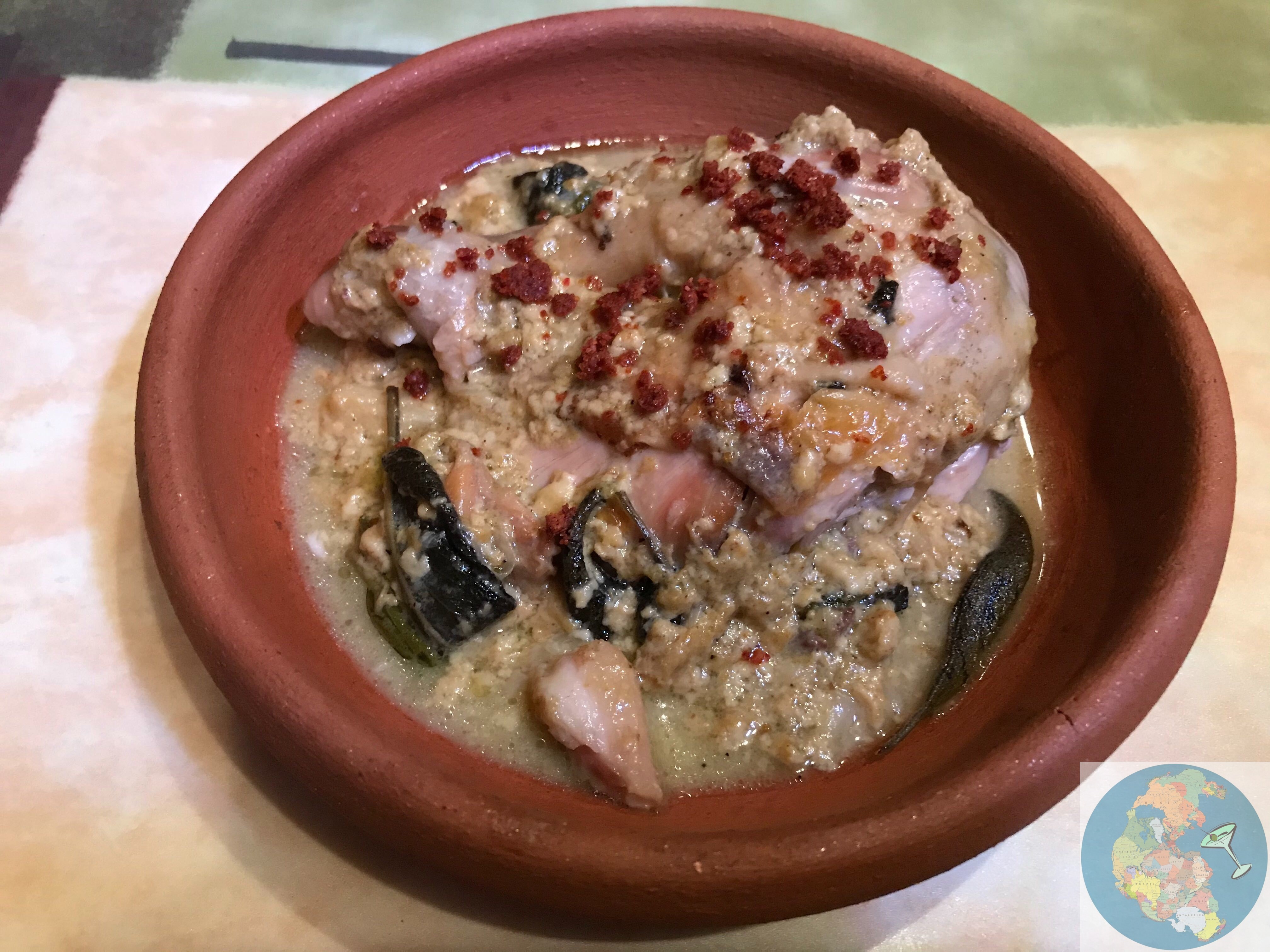
In my recent trip to Tbilisi, I bought a clay baking dish (ketsi) from a subway vendor. We communicated animatedly via miming. Gesturing creatively, she urged me to make chicken in the ketsi (or, so I think!). I also picked up a melange of spices at a street market, from an equally warm vendor whose enthusiastic chatter was translated by her young daughter. This is my homage to the gorgeous Georgian ladies.

Dairy and meat is not a common duo, but inspired by the Tbilisi experience, I present a version of shkmeruli, albeit with some spices (the above street-market spices) and a light, fragrant broth. Enjoy!

Special tools:

Claypot.

Ingredients

  • 3.5 lbs chicken (whole OR thighs on the bone) + salt and pepper to taste
  • Mirepoix: 1/2 cup beet greens, finely chopped, dry roasted, optionally, for about 4 minutes (measures 1/2 cup after processing)
  • 2 cups whole milk + 10-12 garlic cloves crushed,softened in 2 tbsp neutral oil (optional)
  • Georgian spices: 1 tsp Utskho suneli (“foreign” spice or blue fenugreek powder) + 2 tsps kharcho (mixed spices)
  • 10 sage leaves
  • Topping (optional): Georgian Ajika, a chilli-garlic powder

Method

Wipe the chicken pieces dry with kitchen towel and sprinkle salt and pepper on both sides. Brown both sides of chicken in a heavy bottomed pan. If using a claypot, line the claypot with the greens and place the browned chicken pieces on it. Deglaze the heavy bottomed pan with little water and pour on the chicken. If using an enamel iron pot (Le Cruset), add the greens directly and there is no need to explicitly deglaze.

Mix the Georgian spices in milk and pour gently over the chicken. Sprinkle the sage leaves all over the chicken.

Bake covered at 325 F for 1 hour. If not done, remove lid, baste and bake uncovered until interior temp to 165 F. Serve hot with topping.

Notes, hints, tips:
  1. Just a couple of weeks before my travel to the Caucasus, I had experimented with a citrus-milk-chicken stew. In a Baader-Meinhof coincidence I ran into shkmeruli -chicken stewed in milk- at Sakhli, ostensibly one of the top Georgian restaurants in Tbilisi. My version here is slightly different from this classic Georgian dish and I present the citrus chicken below.
  2. If you don’t have Georgian spices, you can substitute with mix of garam masala and coriander powder.
  3. When using chicken thighs, I skin it to reduce the chicken fat in broth.
  4. My Mirepoix: I use dry roasting greens, instead of the classical French technique (eponymous!). Any greens will do- just make sure they are finely diced.
  5. Claypot enables even low-heat cooking; but Le Cruset is a lazier use, since it lets one brown, deglaze and cook in the same pot.
  6. The milk in the stew curdles– providing little cheese curds and a tasty, light broth.
  7. Ajika is reminiscent of the Maharashtrian garlic powder (with chilli, coconut, sesame). Almost all cultures –East Asian to Indian to Mexican– seem to have a version of this lip-smacking, hot, pungent topping.
  • Citrus Chicken: Here is a floral chicken stewed in milk, that is equally gorgeous. Substitute the Georgian spices with:
    Zest of 1 lemon, 2 oranges + 1 orange cut into pieces + 1 tsp ground cardamom + 1/2 tsp ground cinnamon + 9-10 garlic pods, skinned, smashed and softened in 2 tbsp oil
    In fact adding the zest at the end gives a stronger citrus aroma to the dish.

Malwani Chicken: The technique is inspired from above- it turned out like restaurant chicken, but without the oiliness. I used no more oil than the little fat the chicken thighs came with. The artesanal Malwani spice was the high end mix from Mumbai Food Court.
— 1.15 lb chicken skinless, on the bone, thighs. Salt and chilli pepper on both sides. Heat oven-proof calphalon. Add chicken thighs, fat side down to render it. Leave untouched for 1 minute. Then turn the thighs. Add 5 crushed garlic and let it heat till garlic is fragrant.
— Make a mix of 3/4 cup lactose-free skim plus milk (a little sweeter that just skim plus. wonder why) +1 1/4 thin yogurt (made from 1% milk) + 2 tsps Malwani spice mix + salt to taste
— Cook covered at 325 F for 1 hr. Then turn down to 300 F for another 15 mins.

Bengali Swordfish: Does the technique transfer to fish ? Here is the application on a firm-fleshed swordfish. Used the same recipe as above- except used Kalyustan’s Bengal Spice mix and baked at 300 F. Turned out Bengali great!

Silk Road: Georgian Salad

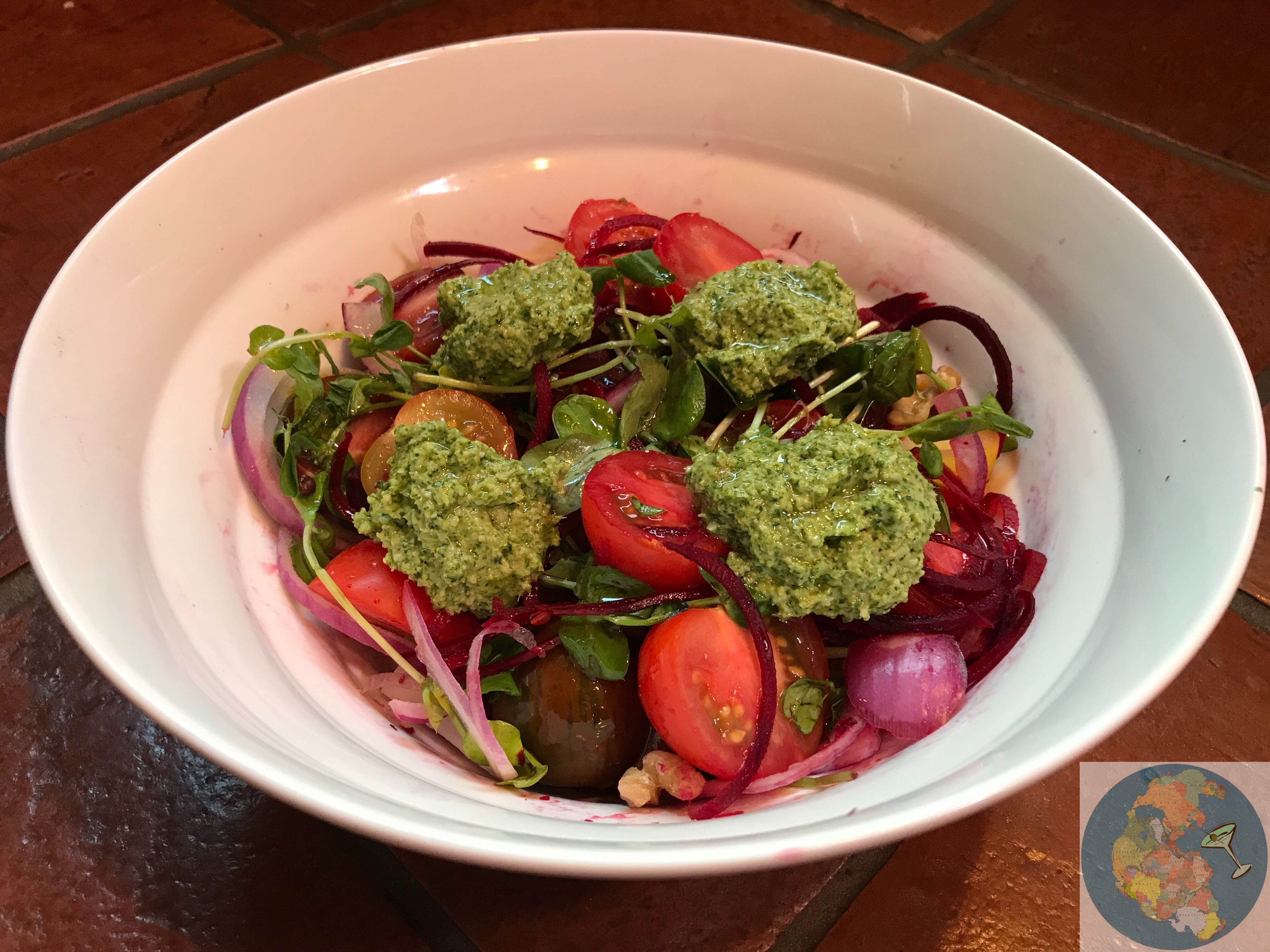
I was blown away by the Georgian salad which I had in Tbilisi and then again in the Qazbegi mountains. Greek-salad-style chunky, the ingredients are reminiscent of the Indian Kachumber (tomatoes, cucumber, onion). I have no doubt in my mind that the salads of these regions of the Silk Road have taught each other a thing or two.

Conspicuously absent are greens (arugula or kale or even the ubiquitous lettuce). Here I use seasonal green pea shoots, albeit in the pesto. I drop the cucumber, since we are already well into Autumn. I dare to add some raw beet (spiralized, of course, masquerading alongside the sliced Spanish onions) and a handful of the micro greens. Dressed generously in a walnut pesto, this salad is bound to steal your heart.

Special tools:

Food processor (for pesto); spiralizer (for beet).

Ingredients

  • Pesto: 2 cups (green pea shoots and a little radish micro-greens) + 1 cup walnuts, toasted with one dried red chilli + 1/4 cup cheese + 2 tbsp vinegar or lemon juice + salt, pepper to taste + 1/3 cup EVOO
  • 2 cups medium sized tomatoes, halved or quartered + 1 Spanish red onion + 1 cup spiralized beet (raw) + 1/2 cup (pea shoots & micro radish greens)
  • Topping: EVOO, a few crushed walnuts

Method

Make the pesto in a food processor. Mix the salad ingredients. Scatter 3-4 dollops of pesto and a dash of the topping.

Notes, hints, tips:
  1. In the right season, you can add chunks of cucumber to the salad.
  2. Ideally I would have added parmesan cheese; instead I used cubes of Manchego cheese and a little goat cheese here.
  3. Beet is a very common ingredient of the region and I unabashedly use it in the salad here.
  4. In the Georgian salad the pesto is not mixed with the ingredients but placed in chunks over it. My friend even mistook it for broccoli.

Silk Road: Olive Trahana

I was exposed to trahana (or, tarhana) on my recent trip to the Caucasus: a sour bulgur. “Sour, how?” you may ask. The grain is steeped in buttermilk and then dehydrated (traditionally, sun dried). I believe there are many Grecian pasta versions with similar name, and, even Lebanese (kishk). As soon as I was back to base, the grain was mail-ordered, which promptly arrived from Turkey.

I experimented with a simple, no-fuss, savory porridge. I discovered that olives and trahana is a marriage made in heaven! Was it my Asian taste-buds? I don’t know; I grew up on neither olives nor trahana. This is certainly worth a try. Enjoy!

Special tools:

None.

Ingredients

  • 1/2 cup trahana
  • a dozen shiitake mushrooms, stemmed, thinly sliced and dry roasted in wok for 2-3 minutes
  • 1 tbsp (store-bought) olive tapenade
  • 1/6 cup diced shallots/Spanish red onions
  • crushed red pepper
  • Greens: 1/4 cup chopped cilantro or parsley

Method

In a wok, soften the onions with a little oil from the tapenade jar (or just use a little olive oil). Add the tapenade and the trahana and stir till well mixed. Add 1 1/2 cups hot water, salt to taste and cover. Cook on low-medium for 20 minutes till the water is absorbed. Let rest for 5 mins (the grains will absorb some more moisture). Mix in the mushrooms and greens.

Serve hot with a dash of crushed red pepper and some tapenade.

Notes, hints, tips:
  1. Note that there is a sweet version of (Turkish) trahana too. Make sure that for this dish, you are using the savory (sour) version.
  2. I use shiitake for some texture and earthiness. I used the stems of the shiitake to make the broth to cook the grains: rough-chop the stems and throw them into the heating water. In fact, I did not even filter out the stems when using the broth/hot water to cook the grains.
  3. You can add other veggies of your choice for texture, color, taste. To retain their identity and character, I recommend folding them in at the end, rather than cooking together with the grain.
  4. The wide mouth of the wok helps in cooking the grain effortlessly, without stirring frequently etc.
  5. I tried a thinly shaved cheese (Manchego) topping that went well too. Perhaps not as magical as the olive tapenade.
  6. The trahana becomes naturally creamy. You can control the final texture by controlling the level of moisture that remains in the end.

A quick, complete meal with tarhana. The purists may be taken aback with the use of sardines. Quite delicious!
The same recipe as above, with additional 1 tbsp Ottoman spice-mix + 2 tbsp EVOO. Finally added 120 g can of sardines and mixed well.