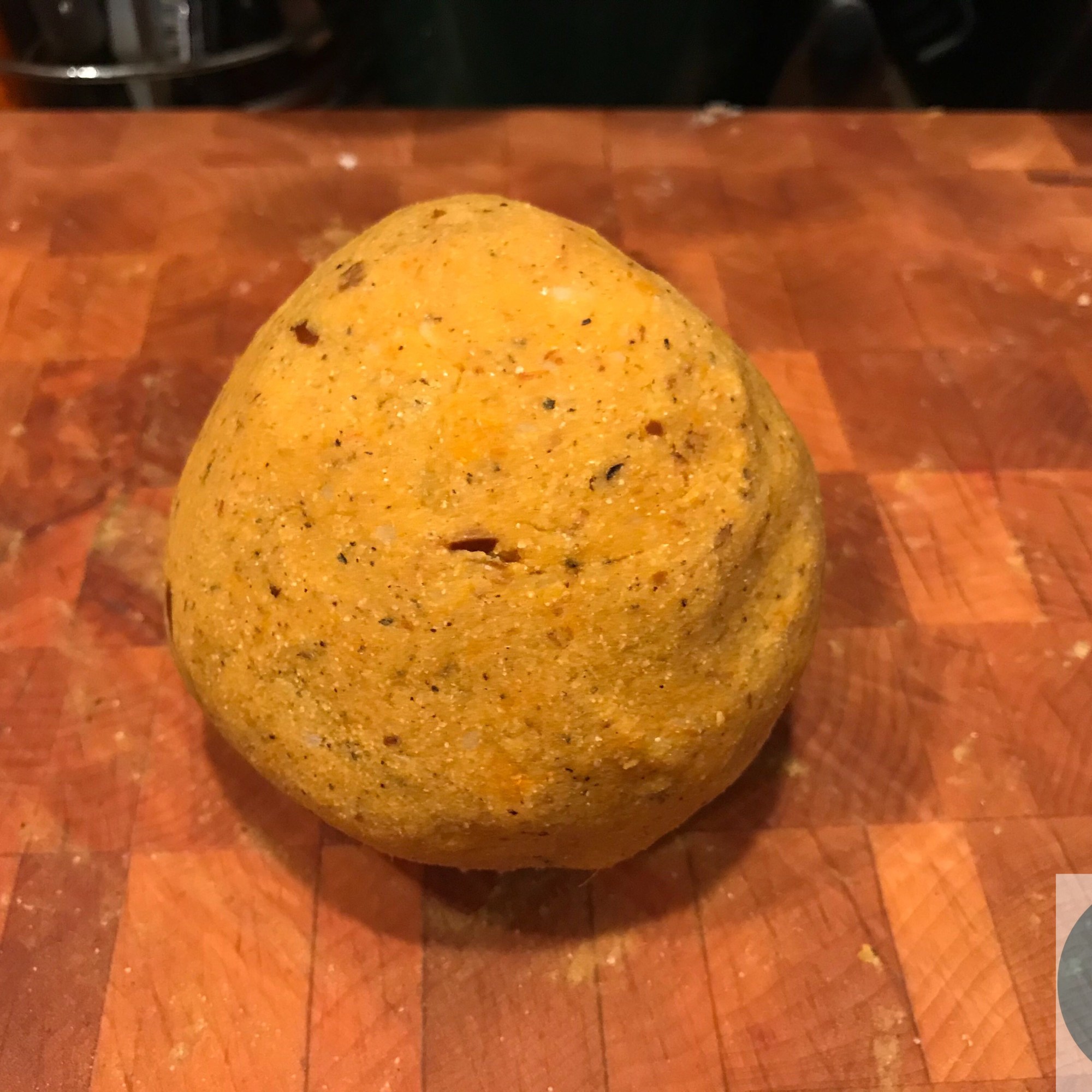
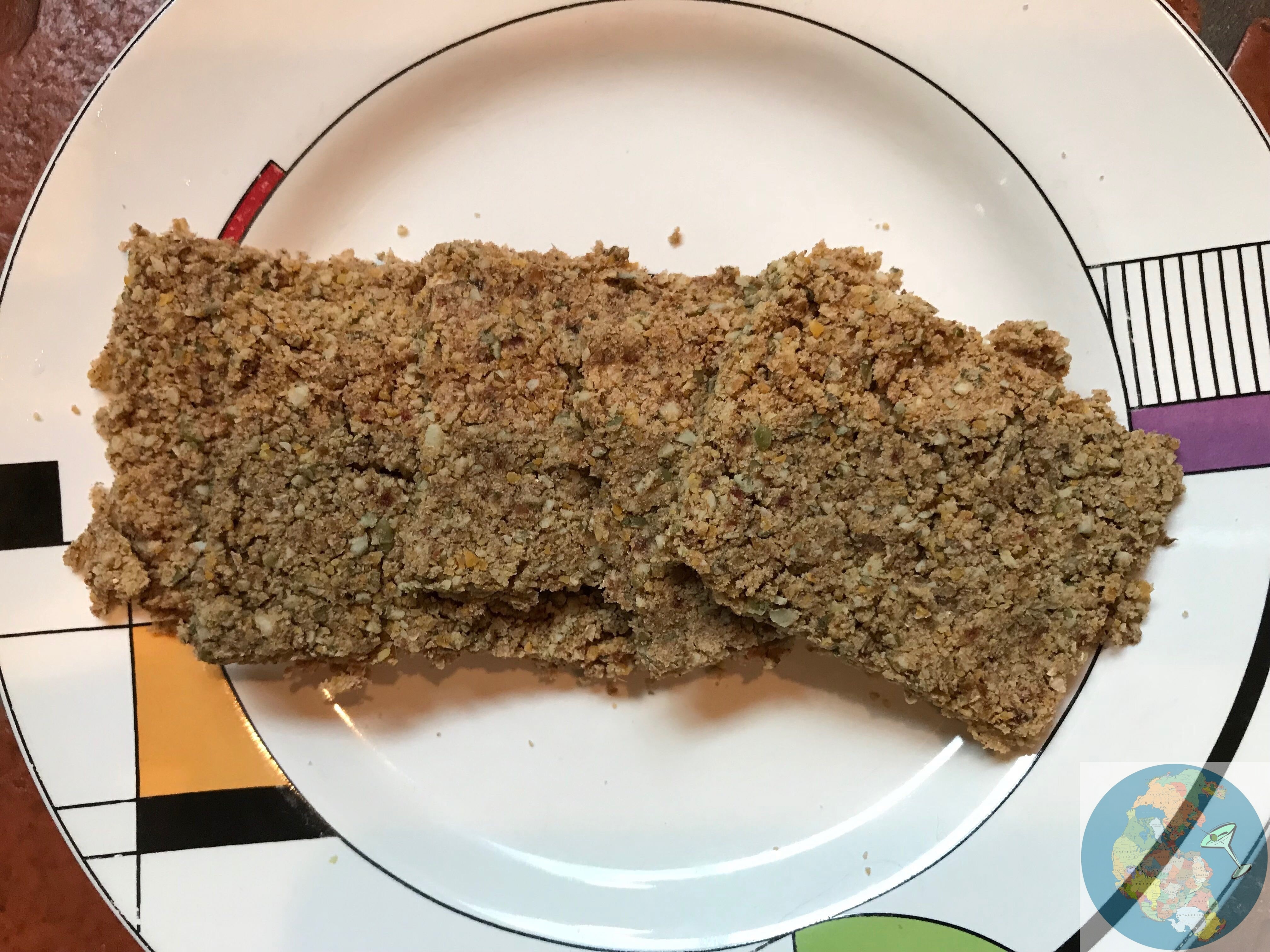
Honeynut Squash: Easy Petit-Dumplings

Gnocchi is an Italian dumpling made with flour and a mainstay ingredient (usually potatoes) and another usual suspect, egg. Poached in water and dressed in a light sauce, it is an absolutely delicious pasta. Italians, take a bow!

Gnocchi-making takes some expertise. The flour in the classical gnocchi plays a vital structural role for handling and shape-retention (with egg) in the unforgiving boiling water.

I present here a friendly version that you can knead simply, roll, cut and shape. I strike out the egg and cut the flour down to absolute minimum (just enough to absorb the excess moisture). And, just microwave (instead of poaching) to retain the delicate shape of the dumplings. With squash as the only ingredient -and, potatoes as the invisible delivery agent-, the pristine honeynut, with a dab of EVOO, shines. Enjoy!

Special tools:

Food processor; potato masher or ricer.

Ingredients

  • 1 honeynut squash halved lengthwise and the internal pulp and seeds removed
  • 3-4 small potatoes
  • 1/4 cup flour (buckwheat)
  • Seasoning: salt and pepper to taste
  • Dressing: EVOO and sea salt

Method

Place the halved honeynut squash with the cut side up on a baking tray. Brush with EVOO. Roast at 400 F for 30 mins. Run the squash, with skin, in the processor.

Wrap the potatoes in damp kitchen paper and microwave for 4 minutes; peel and mash while still warm, mixing in the processed squash. Add the seasoning and the flour to knead lightly. Cut the dough into four equal-sized pieces. Roll each piece into a rope of 1/2 inch thickness and cut into (roughly) 20 little cylinders. Lightly mark with a fork. Place on a platter and refrigerate till ready to cook.

Cover with damp kitchen towel and microwave 20 at a time for 1 minute. Mix lightly in the dressing and serve.

Notes, hints, tips:
  1. The recipe makes 20 X 4 = 80 gnocchis.
  2. Using buckwheat flour and omitting the eggs gives gluten-free, vegan dumplings.
  3. If the squash is hard to cut, microwave for 2 minutes or so till it just softens enough for the knife to run through.
  4. The skin of the squash will be in bits but not completely pulverized. if you don’t like this texture, you can remove the peel. My recommendation is to use the peel: it breaks the monotony of a smooth texture. Also, the peel has more nutrients than the interior flesh.
  5. I used buckwheat flour, but you can use regular white flour. And, even an egg.
  6. Even just EVOO makes this little gnocchis irresistible. But you could use other elaborate sauces of your liking.
  7. See the Honeynut Squash Mousse, for an alternative treatment. Simple too.

Silk Road: Lavash to Swirly Roomali Roti

Along the Silk Road theme, I present homemade Lavash bread of the Caucasus. Perhaps the precursor of the Indian Roomali Roti (literally, handkerchief bread). [I am sure that the Jewish matzo is a close sibling somewhere on that taxonomy.]
Lavash is traditionally made in a tonir (a tandoor) in Armenia, where the incredibly thin, oval, flat bread is slapped on the inside of an extremely hot tonir and the bread cooks rapidly. A creative chef came up with the idea of using an inverted bowl/kerai/wok to make the handkerchief-thin bread rapidly in the kitchen or even at roti counters at restaurants. I have to research the origin of this ingenious idea, that is so ubiquitous in India.

I must confess that this is a difficult one and requires some flat-bread (roti) making expertise. But if you have some basics under your belt, this is well worth a meditative challenge. It is amazing what just flour and water can produce! In this rendition, I give a swirly take on the classic with activated charcoal.

Special tools:

Rolling pin and board; thick bowl or wok or kerai.

Ingredients

  • White dough: 1/2 cup whole durum wheat flour (atta) + 1/2 cup white all-purpose (maida) flour + salt
  • Black dough:  1/4 cup atta + 1/4 cup maida + 1/2 tsp food-grade charcoal powder + salt

Method

A. It is important that the dough be soft- make each dough with water. Rest them for at least 15-30 minutes, covered with damp kitchen towel.

B. Divide each dough into eight equal-sized parts. Then roll each in your palm of your hand into ropes. If not malleable, rest the dough again to make it so till you can get an even rope of length 10-12 inches. Pair a white and black rope (the black will be slimmer than the white) and swirl into a disk as shown in the pictures. Cover with damp kitchen towel and let them rest for at least 10 minutes.

C. Using plenty of bench flour (white flour), flatten the disk and roll using your pin until the roti is at least 10 inches in diameter. Cover with damp kitchen towel and let it rest.

D. Heat the inverted kerai/wok on HIGH heat- you will be making the roti on the concave surface (not convex!).

E. While the wok heats, for the final “roll” use your hands to slap the roti from one hand to the other, while flipping it (I learnt from the Armenian women –who are primarily the Lavash makers– that you can use your forearm as well while flipping, particularly since the traditional Lavash is large and oblong shaped). When your knuckle shows through– it is thin enough.

F. The kerai must be very hot by now; place the roti on it. Flip after 30 seconds and 15 seconds on the other side. Don’t overcook- then it will harden.

G. Fold into quarters and keep covered till ready to serve. Go to Step E. to make the next roti.

Notes, hints, tips:
  1. You can always make just a white roomali roti. 1 1/2 cups flour (50 % atta, 50% maida by volume) makes 8.
  2. Do NOT destroy any sophisticated (not-stick etc) wok on this. I used a much-beaten, old kerai (that was on its way out) for this and it turned out perfect. Time and over-use had already seasoned it. Resurrected, now it occupies a new, special place in my cabinet.
  3. Flatbread / roti making is usually accompanied by “flour-shower” in the kitchen (haha!) that will take some cleaning-up effort. But well worth the trouble.
  4. Here’s what makes a roti roomali:
    • (a) white flour in the dough to provide the gluten for it to stretch thin;
    • (b) soft-soft dough, but using plenty of bench flour to roll (some suggest to use milk instead of water to make the dough);
    • (c) rest the dough, covered with damp kitchen cloth as often as necessary, and, more;
    • (d) HIGH heat cooking for about 30 secs on each side- as you place the roti on the metal surface, it should immediately start puffing.
  5. Can’t do the air-flipping of Step E: No worries. Roll it thin using the rolling pin. Can’t roll thin: No worries. See the following.
  6. Can’t roll thin enough (or only upto 6-8 inches diameter): No worries. Follow the exact process, but roast for about 45-60 secs on each side. Just before serving, puff it on the open fire (ala Indian phulka). It may not be roomali, but will still be a deliciously soft roti.
  7. In Yerevan, I saw hard Lavash being sold in the markets: the makers and sellers were almost always women. In any case, if you wanted your Lavash soft, they sprayed water on it. How clever!

Lahmacun: In Istanbul I learned the trick of a quick lahmacun with store bought lavash bread. The following filling:bread ratio is more than the usual. But very, very delicious!!
Filling: 1 lb ground lamb + finely diced (1/2 large red onion, 1 tomato, 1 green pepper, 1/2 bunch of parsley)
+ salt + black pepper + red chilli pepper + 1 tbsp EVOO
Use a base of two layers of store bought lavash bread on silpat on baking tray. Divide the filling into four and spread it out on the lavash bread. Brush the meat filling with cold water.
Bake at 500 F for 10 mins.

Silk Road: Charcoal-Grilled Lamb & potatoes

Whether the New World Barbecue or the Silk Road claypit-fire, there is something primal, appealing and heart-warming about grilling.

Inspired by the Armenian khorovats, I give here an absolutely delicious, finger-licking version. In Yerevan, my Armenian friend told me that they don’t use any flavorings to appreciate the natural flavors of meat. Sorry, I deviated. I use an allium-flavoring (onion, garlic) and also a tenderizing element (citric acid).

Special tools:

Metal skewers; bamboo skewers for the vegetables; charcoal grill, oven to roast the vegetables.

Ingredients

  • Meat:
    • 2 lbs (deboned) butterflied leg of lamb cut into chunks (+ 2 lamb chops)
    • Liquify in a blender-  1 large onion +  5-6 cloves of garlic + 1 tsp extra hot chilli powder + black pepper + 1 tsp citric acid [both a tenderizer and gives an acidic tang] OR 1 cup papaya [unripe or ripe, a tenderizer]+ salt to taste
  • Vegetables:
    • 1 lb fingerling potatoes, skewered whole, brushed with some oil
    • Dressing: salt + pepper + finely chopped herbs (cilantro, mint) + juice of half a lemon

Method

Marinade the meat overnight. When ready to grill, skewer the chunks and grill, rotating the skewers every now and then, basting with the marinade, till done. (See here for an alternative to skewering.) Pull the meat off the skewers with Lavash bread (ala Armenian) and serve the meat on the platter lined with the homemade Lavash.

Roast the potatoes in the oven at 400 F for about 30 minutes (turning half way through). When done, pull off the skewers and lightly dress the potatoes to serve.

Notes, hints, tips:
  1. Other vegetables to grill: onions, tomatoes, Brussel sprouts, eggplant, zucchini etc. I skimped here due to some constraints.
    I used bamboo skewers for the vegetables- remember to soak them for at least one hour, so that the dry skewer does not spontaneously ignite.
  2. The grilled chunks are also known by other names: boti/shish kebab (Arab/Indian subcontinent) or shashlik (Russian/Caucasus) or souvlaki (Greek).
  3. The citric acid (food-grade) tenderizes the meat and makes the texture absolutely pleasant. Not chewy at all. Another classic tenderizer is green papaya (usually pulverized into a paste for the marinade).
    Make sure to marinade the meat for at least one hour or overnight if possible.
  4. If you don’t have the means for an open fire charcoal grill, you can broil in your oven with equally delicious result.
  5. I grill the potatoes in the oven, since I found the open-fire grilled potatoes burn before cooking. You can also wrap them in alumunium foil and place on the grill. But I prefer the former method.
  6. The 2 lbs of meat required 4 skewers (each about 17-18 inches long).

Black Lime Chicken Skewers: Finger-licking chicken skewers inspired by Ottolenghi’s Test Kitchen book.
Marinade 1.5 lbs skinless, boneless chicken thighs cut into 1 inch cubes: 3 tbsp black lime powder + 2 tsp lemon zest & 2 1/2 tbsp juice from 2 lemons + 1 tbsp cumin powder + 6 garlic cloves minced + 2 tbsp olive oil + black pepper or urfa biber + salt
Marinade for about 1 hour and the grill till done. Serve with pickled onions (1 thinly sliced red onion in 2 1/4 tsp apple cider vinegar+ 1 1/2 tsp sumac), flat bread or lettuce leaves and farro grain.

Silk Road: Beet-Herbs Stuffed Black-&-White Flatbread

My dream is to go caravenserai-hopping along the Silk Road, savoring the flavors our ancestors deemed worthwhile to share with neighbors. This wish came partially true with my recent trip to Armenia.

I think it is a sacrilege to mess with classic recipes; but I cannot not give a modern twist. So here goes my “black & white” version using a current fad, activated charcoal. The Armenian Jingalov hat -herbs stuffed unleavened bread- is perhaps the precursor to the Indian stuffed paratha. I use here the whole wheat durum flour (atta), instead of white flour. Also in the stuffing, I throw in some golden beet pulp. These turned out scrumptious, barely making it out of the skillet onto the serving platter.

Special tools:

Rolling pin and board; iron skillet.

Ingredients

  • Stuffing: 1/2 cup beet pulp + 1/4 cup each of finely chopped scallions, finely minced mint, cilantro + onion powder + salt + red pepper
  • White dough: 1 cup atta + salt + water
  • Black dough: 1 cup atta + 1 tsp charcoal powder + salt

Method

Make the two soft doughs separately. Rest them for 15-30 minutes. Divide each dough into five equal-sized balls. Take one of white and the black ball– flatten them jointly into a disc approximately 6 inches in diameter. Place about 1/2 loose cup of stuffing in the center. Gather the edges, seal and gently roll thin (about 1/2 cm thick). Use generous amounts of bench flour to make it easy to handle. Brush off excess flour from the bread before cooking.

Notes, hints, tips:
  1. The classic recipe uses only herbs for stuffing; you can use other greens as well. I used the beet pulp — the leftovers from the cold pressed beet juice– since it is dry enough to be a stuffing. You can use the juice for other drinks.
  2. The dough should be really soft to handle. It is better to err on the softer side; since the resulting bread will also be soft.
  3. You can use a dry skillet to cook the bread, or, if you like in a paratha style — to use a little oil on the skillet.
  4. The charcoal powder is food grade, apparently in the superfood category these days. It does not impart any taste– just a black color that you can use to your advantage.

Devilish Beet Shot

This year on Labor day, a planned kayaking trip was shot by inclement weather. An idle mind is the devil’s playground, so goes a wise saying, and, here is a devilish drink that tastes even better than it looks! Even if the earthy beet juice is your thing, try this version that elevates it to a festive shot. Enjoy!

Special tools:

Cold press juicer, Sparkling water maker.

Ingredients

  • 2 oz cold-pressed beet juice (red or golden)
  • 2 oz homemade (chilled) sparkling water
  • a dash of ginger-honey balsamic

Method

Place the juice and the balsamic in a serving glass. Pour the sparkling water over it and serve.

Notes, hints, tips:
  1. A cold press (masticating) juicer is used here to extract the juice from a bunch of beets. You can always replace with store-bought juice.
  2. If you don’t make your sparkling water at home, you could replace with store-bought one.
  3. Let your creativity run wild in finding a replacement for ginger-honey balsamic 🙂

Nuts Bar

Sweet, delicate, exquisite as the snowflakes of (Bolshoi) Nutcracker! Use as breakfast bar, your travel bar or simply a snack bar.

The recipe is adapted from Pamela Ellegan’s book on dehydrating. Lest a dehydrator is not in your toolbox, I use the oven here by conflating with the technique from Norwegian knekkebrød.
[Do scroll down to check out all the awesome varieties of bar formulae that I have added.]

Nuts Cracker Bar
Special tools:

Food processor; silicone silpat; oven.

Ingredients

  • Nuts soaked overnight for 6 hrs: 1/2 cup pecans + 1/2 cup hazelnuts with 1/2 tsp Himalayan sea salt in plenty of water
  • Seeds: 1/2 cup whole pepitas or sunflower seeds + 1/2 cup flaxseed meal
  • Sweetening tignum : 1/2 cup pitted dates soaked in water for 30 mins

Method

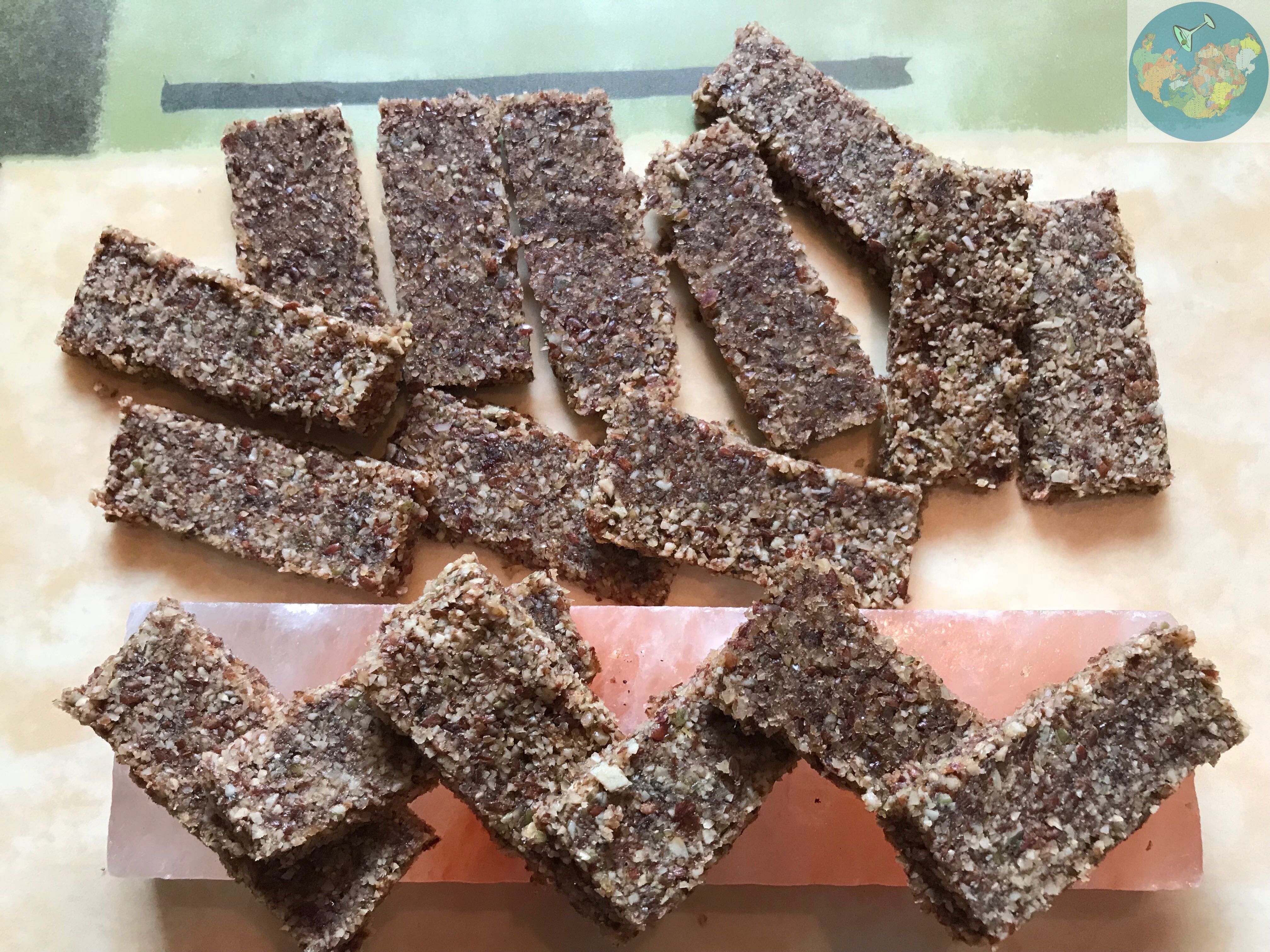
Drain all the soaking ingredients. (Note the flaxseed is not whole.) Save the draining liquid of the dates. Run all the ingredients in a processor, adding the date liquid gradually, till it holds together lightly. Then spread it thin on the silicon mat with the spatula of the processor to a rectangle approximately 8 inches X 10 inches. Score lines on it. Place on a wire rack and bake at 175 F for 1 1/4 hours. Remove from the oven and let cool on the rack. Makes 32 bars.

Notes, hints, tips:
  1. I place a lid (parchment paper) just on the surface of the water to ensure that all of the nuts are constantly submerged. I attribute this ingenious technique to the Japanese, although you may be more familiar with it as cartouche (a French term that is more popular, thanks to the world history of the last few centuries).
  2. Let the bars dry thoroughly, although quite tempting to have them right away: it may be a little sticky to the teeth. When completely dry, they don’t stick.
    I am in the hunt for an even better binder than dates, albeit with equally good-health endorsements and ready-to-consume sans cooking characteristic.
  3. Feel free to bake longer, for a crispier effect.
  4. I soaked the nuts in the morning; baked in the evening and let it cool overnight.

Garbanzo Bar: Here is a bar that uses legume (garbanzo) instead of the nuts.
1 cup cooked garbanzo (not mushed) + 1/2 cup sunflower seeds + 1/2 cup psyllium meal + 1/2 cup dates soaked in water for 30 minutes + a dash of vanilla
Process as the recipe above adding the liquid of the soaking dates till it holds together. Spread thin in a silicon mat and place on a wire rack. Bake at 175 F for 2 hrs. Check after the first hour and then every 30 mins. Let cool overnight. 

Beet Bar: Here is a bar that uses beet pulp from the juicer and beet juice. Absolutely addictive, I promise!
I am told that soaking the raw (not toasted) nuts and seeds with a little salt activates them, making them easier to digest and absorb. In general use 1/2 tsp Himalayan salt for 1 cup nuts/seeds.
The texture is a little “bready”: so you can also halve the recipe and spread even thinner on the silicone mat to the same area and bake for the same amount of time (3 hrs) at 170 F. See picture at bottom.

1. Seeds/Nuts (soak in 1 tsp Himalayan sea salt and plenty of water for 12 hours to activate):  3/4 cup sunflower seeds [or pecans or almonds] + 1/2 cup pumpkin seeds + 1/8 cup chia seeds + 1/8 cup poppy seeds + 1/6 cup flax seeds [or blend of seeds & ancient grains (see picture)].
2. Drain the soaking seeds. Process with the following ingredients till well blended and pliable.
— 1  cups rolled oats + 1/2 cup beet juice pulp +
— 1/4 cup fresh lemon juice [or lemon flavored balsamic] + 1/4 cup EVOO + 1 tbsp psyllium husks + 1 tbsp fresh beet juice + 1 tsp Himalayan salt
3. Spread thin on a silicon mat (approximately 18 inches X 12 inches) and bake directly on a wire rack at 170 F for 3 hrs, checking after each hour.

Thinner version (1/2 the Beet Bar recipe):

Cacao-Orange Bar: A fragrant bar that will blow your mind- using the classic combination of chocolate and orange.
1 cup pecans (soaked with 1/2 Himalayan salt for 8 hrs) + 1/2 cup flaxmeal + 2 tbsp psyllium + 1/8 cup cacao powder + zest of 1 orange + 1/2 tsp vanilla essence (to kill the earthy flaxseed flavor) + dash salt + 1/2 cup dates (soaked in orange juice for 30 mins)
Process as the recipe above adding the orange juice of the soaking dates till it holds together. Spread thin in a silicon mat and place on a wire rack. Bake at 175 F for 2 hrs. Check after the first hour and then every 30 mins. Let cool overnight.

Plantain Wafers: Plantain is one of my absolute favorites! Inspired by my Mom’s kadali kofta and Pamela’s Peurto Rican Mofongo, this wafer is bound to steal your heart! The fennel gives a nice anise-accent.
1. Steam three green plantains (not sweet ones) with skin for about 10-12 minutes. Peel while still warm.
2. Run in a processor the steamed plantains with 1 cup chopped fennel +3 tbsp flaxseed meal + 1 tbsp oil (coconut oil) + 2 pods of garlic + salt and pepper to taste. Process till it holds together when pressed into a ball.
3. Make little balls and dot a teflon or silicon base. Flatten and roll thin. [Easy to place another teflon sheet on it and use a wine bottle, if you can’t access a rolling pin.]
3. Bake at 175F for 2-3 hrs until fully dehydrated.
4. Pamela’s Sweet-Sour-Hot Sauce: I am not a big fan of raw garlic, but I will make an exception for this one: the garlic mellows in the powerful agave and cider medium. Mix 1/4 cup agave + 2 tbsp apple cider vinegar + 1 tbsp (or to taste) cayenne pepper + 1-2 pods of finely crushed garlic + salt to taste.

Chipotle Corn Wafers: Influenced by Rachel Carr’s book Modern Raw. The wafer is fantastic!
1. Run in a processor into a soft paste: 2 cups corn kernel + 3/4 cup flaxseeds pulsed into meal + salt + 1/2 tsp cumin seeds +1 tsp chipotle powder + salt to taste + juice of 1/2 lime.
2. Spread thin on two teflon sheets.
3. At 175 F for 2-3 hrs until dehydrated. No need to even flip.
4. Break off the wafers into artisan pieces and serve.

Granola: Influenced by Sara Dickerman’s Dried and True. I replace egg whites with homemade whey. The latter is an even better binder.
1. 1 1/2 cups rolled oats (not quick-cooking) + 1/4 cup toasted coconut slivers (called chips) + 1/4 cup toasted slivered almonds + + 1/4 tsp cinnamon powder + 1/4 tsp cardamom powder + dash sea salt
2. Tignum fudge: 1/8 cup coconut oil + 1/2 tbsp butter + 1/8 cup condensed milk + 1 oz whey + 1 tbsp brown sugar
3. 1 oz cold whey, beaten well with wire whisk (or 1 egg white)
4. Mix the tignum fudge ingredients on low heat in a small pan for a few minutes until well-mixed and pour over the rest of the ingredients. Fold in the beaten whey. Spread on silpat on a wire rack.
5. At 175 F for 4 hrs until dehydrated. No need to even flip.